
UNC Center for Health Promotion & Disease Prevention
Design Thinking for Community Programs
Are you seeking to improve how you incorporate input from your primary audience into the development of your community-centered programming?
Design thinking may help!
Design thinking is a people-centered approach to learning about a problem and developing a solution. Design thinking methods and tools are flexible, adaptable, and help organizations work collaboratively with communities and individuals who are most impacted by the identified problem.
Design thinking can help advance community-centered work by:
-
Engaging community members in the design and adaptation of programs and initiatives that center their needs and consider their barriers.
-
Ensuring resources support effective and desirable programs, leading to greater engagement, effectiveness, and higher levels of retention.
-
Reducing the amount of time and money spent on correcting implementation challenges.
-
Providing tools to consider and advance equity in community programs.
Design thinking can be integrated into community-led programming in a variety of ways:
-
Conducting assets & needs assessments
-
Adapting interventions
-
Monitoring or evaluating an implemented intervention
-
Develop training programs for staff and community partners
\
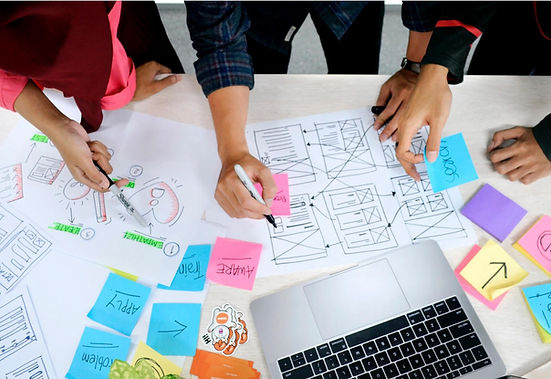
Image to the right is a sample output from a design thinking workshop series with community members about household food waste

See below our projects that employed design thinking principles and their products :
Journey mapping with low-resource Latina moms to learn how they budget for healthy foods
-
Caregivers of young children to determine how to impart food skills education in various settings using journey mapping, inspiration sessions, collage activities and other strategies.
-
Learn more about this project:
-
Adapting Design Thinking Methods and Best Practices to a Virtual Environment: Lessons Learned and Future Considerations by Jared Bishop, Claire Sadeghzadeh, Eduardo Hernandez, Liz Chen, Alice Ammerman, Tracy Dearth- Wesley, and Molly De Marco
-
-
Human-centered design workshop series with parents and caregivers of young children to develop food retail interventions to promote healthy food purchasing
-
FFORC and Share Our Strength’s Cooking Matters convened parents and caregivers of young children (0 – 5 years old) in a series of human-centered design workshops to learn about how SNAP-Ed could center their needs and desires when developing food retail interventions promoting healthy food choices.
Guide of key Insights and learnings
-
The Using Human-Centered Design to Test Food Retail Strategies guide highlights the key insights and learnings from these sessions and provides two intervention frameworks prioritized by caregivers – a meal box intervention and a rewards program. The intervention frameworks were co-created with food retail stakeholders, SNAP-Ed Implementing Agencies, and caregivers using human-centered design methods. The guide will walk you through how to use human-centered design methods to select an appropriate intervention framework as well as how to test and refine the framework to your local context.
Want to explore a partnership with us to implement
design thinking in your community programming?
Our team can help you:
-
Draft language to include in your intervention plan to conduct design thinking activities with our guidance in the coming fiscal year;
-
Design and deliver user-centered (virtual or in-person) design thinking activities with community and implementation stakeholders;
-
Synthesize and present data and learnings from design thinking activities for local and state agencies, partners, and your primary audiences through written and visual products; and
-
Provide training and technical assistance to learn more about design thinking.
We can help you engage the communities you serve in new ways and build trusting relationships with partners to deliver programs. We are eager to share our tools and expertise with you as you adapt design thinking to your work!
To learn more about how we may help you use design thinking to
move your work forward, email us at hpdpfforc@gmail.com.